Birch Plywood
Birch is a plywood product native to the northeastern region of Europe around the Sea. It’s manufactured for European cabinetmaking. Birch’s core is unlike traditional plywood you may be used to seeing: the layers of inner plies are 1.5 mm-thick solid birch veneer, cross-banded, and laminated with exterior grade adhesive. It’s a recipe that results in a void-free core with a number of advantages, which is why in the India and abroad we’ve discovered that the material is fantastic for thousands of projects in woodworking.
a. Size: 8×4 feet in vertical and horizontal grains
b. Thickness: 6mm, 9mm, 12mm, 16mm, 19mm, 25mm
c. Grade: MR, WBP
7 Reasons Why Birch Is a Preferable Plywood
- Superior Screw Holding
Because the core layers of Birch are actually veneers of birch (rather than a softer, secondary wood) and form a void-free core, screws bite and hold with 100% of their threads. Conversely, traditional veneer core plywood has voids and is also made up of softer materials so screws don’t get a chance to clench the best they can. You also might find sheet goods made with MDF (medium-density fiberboard) core, and though it’s 100% solid, MDF is soft and just doesn’t have the screw-holding power of birch.
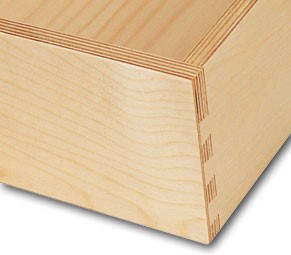
Solid joinery like half-blind dovetail joints are not only possible with birch, but they look good too.
- Cleaner Joinery
Tipping the hat once again to the uniform birch veneer layers of the core, you’ll get clean dadoes, rabbets, dovetails, miters, and fingers for strong and, when appropriate, great looking joints. Because the core is free of voids, your joinery also won’t suffer from glue starvation—they’ll get 100% glue coverage. Anything you build out of birch should last a good, long time.
- Improved Strength and Stability
All plywood runs the risk of warping, and the most common type of warp in plywood is bowing. Birch is not immune, it’s still a wood product. However, Birch has the odds stacked in its favor much better than other plywood, chiefly in 1/2″ and 3/4″ thickness. The cross-banded layers of 1.5 mm thick birch veneer makes the sheets balanced, which promises a flatter product. However the thinner sheets, like 1/8″ and 1/4″, simply will not remain flat in large pieces—and this is no surprise. That’s usually not a problem though because these are usually used in applications like drawer bottoms and cabinet backs where they’re cut down to smaller sizes or captured in dadoes and rabbets. It should be obvious that the thicker sheets are more stable because they have more plies. 3/4″ Birch in particular won’t change much in width or length, that’s why it’s great for jigs and fixtures that need to maintain accuracy over the years.
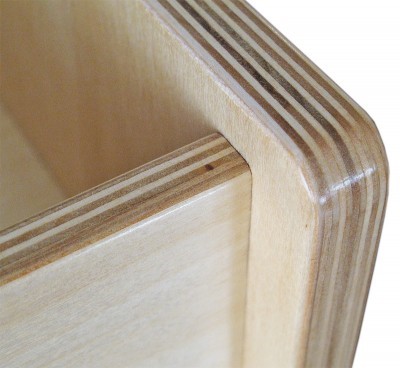
Birch edges don’t look too bad when shaped, sanded and finished.
- Attractive Appearance
One of the fortunate benefits to Birch, too, is that you can leave the edges exposed if you like the look. Because the core is free of voids and all birch, the exposed edges sometimes have an appearance that works for the project, and this saves you time and material—no need to spend time and effort on applying edge tape or solid edge banding unless you want to. Simply sand and finish the edges as they are. The face and back can be stained when you need a different color. Like solid birch lumber, for it to stain evenly with an oil based pigment stain you’ll need to apply a stain controller or a wash coat of de-waxed shellac. Otherwise use dye for even color. To keep the uniform, light color instead, simply finish Birch with a basic clear top coat of lacquer or polyurethane.
- Thicker Face Veneer with Reasonable Quality
With close inspection of Birch, you should notice that the face and back veneers are remarkably thicker than the veneers you’ll see on traditional cabinet-grade plywood. Sadly, it’s well-known that cabinet grade plywood veneer faces are dismally thin, which makes them easy to damage and easy to sand through. But not so with Birch. Outer veneers are nice and thick. As for the appearance, there are several grades of Birch available, but we most often carry the highest grade which is B/BB. Plywood has two sides a face and a back—meaning one side is going to be better than the other, and they’re graded separately. B is the grade of Birch’s face, or the best side. It’s a whole-piece face with no splices, has a light and uniform color, and there are no patches, mineral streaks, knots or voids. The back side is graded BB and slightly less attractive. There can be up to 6 color-matched “football” patches (about the size of a large egg), mineral streaks and small-but-sound dime-sized pin knots.
- Accepts Paper Back Veneer for More Decorative Projects
If you like everything about Birch except its outer birch appearance (or occasional “football” patches), no problem. You can face this plywood with any kind of beautiful wood veneer. Be sure to veneer both sides to maintain its stability.
- It’s Just the Thing for Laser Cutting and Engraving
It’s one of the few types of wood that can come in large enough sheets and yet be consistently dense through its thickness to be cut with a laser. Anything from parts for architectural models to artwork to schmaltzy engraved knick-knacks.
The downside is that 1/8″ and 1/4″ thick Birch can’t stay perfectly flat. It does cup or warp. It’s not because it’s bad plywood but just an effect of the size. It’s thin and wide. Not a good combo for getting wood to lay flat.
For Inquiries, please contact :
Warehouse Address:
FSD Building Materials Private Limited
Delhi Address:-
Property No. 6 & 7,
Khasra No. 132/10/02
Near K.S Dharam Kanta, Mundka,
Delhi- 110041, India
delhiwh@fsd.in
Bhiwandi Address:-
Padmini Complex, Building No. A-7,
Gala No.4,5,6, At Purna Village,
P.O Kalher, Taluka Bhiwandi,
District Thane-421302